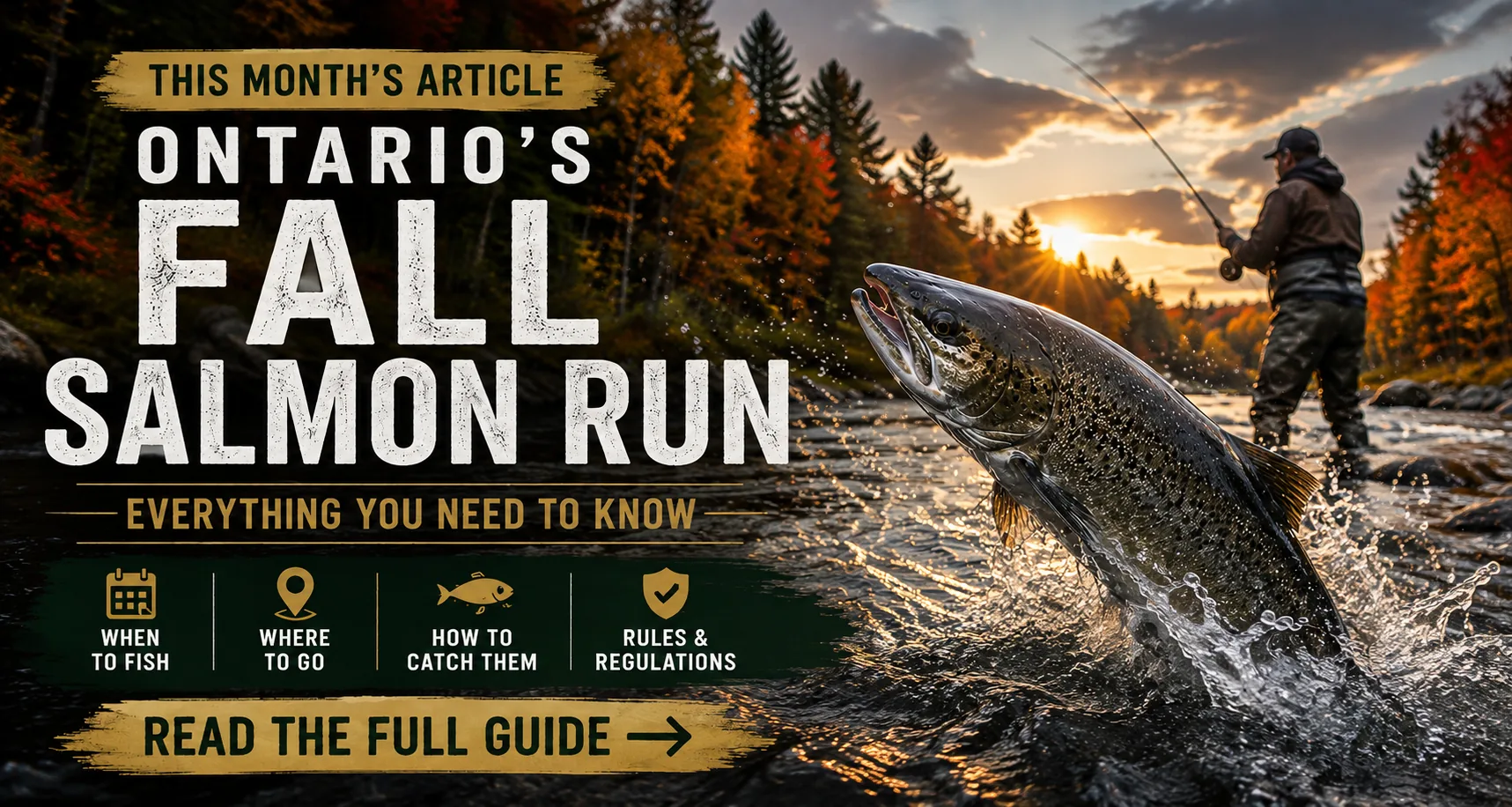
Every autumn, some of the biggest fish swimming in Ontario leave the open waters of the Great Lakes and push into rivers that, only weeks earlier, may have looked almost empty. For anglers, photographers and anyone interested in Ontario's outdoors, the fall salmon run is one of the province's great natural spectacles.
There are few sights in Ontario fishing quite like a mature Chinook salmon appearing in a shallow river.
One moment you're looking at an ordinary stretch of September water. The next, a dark shape materializes behind a boulder, a tail breaks the surface and 20 pounds or more of salmon surges upstream through water that barely seems deep enough to cover its back. And there could be many more behind it.
From Lake Ontario tributaries through Georgian Bay, Lake Huron and all the way north to Lake Superior, fall brings migrating salmon into Ontario rivers and creeks. Chinook are usually the stars of the show, but coho, Atlantic and, particularly around Lake Superior, other Pacific salmon can also be part of Ontario's autumn fishery. Ontario classifies Chinook, coho and pink salmon collectively as Pacific salmon in its fishing regulations.
But the story behind these fish is almost as interesting as catching one.
Why Salmon Suddenly Appear in Ontario Rivers
For much of the year, Great Lakes Chinook salmon live in the cold open water, feeding and growing before eventually returning to tributaries to reproduce. Ontario describes Chinook as spending most of the year in the Great Lakes before returning to tributary streams to spawn.
As summer begins to fade, mature fish start gathering — or staging — near river mouths.
Lake Ontario fisheries information from the New York Department of Environmental Conservation describes mature Pacific salmon beginning to stage off tributary mouths from roughly mid-to-late August, with fish beginning to enter rivers in early September. Tributary fishing commonly continues into early November, although the strongest part of the run is much shorter. Rainfall and river flow can have a major influence on when salmon move into streams that do not have controlled flows.
That explains a familiar Ontario pattern. A tributary can look almost devoid of salmon during a warm, dry September spell. Then rain arrives, the river rises, temperatures begin falling and suddenly fresh fish start pushing upstream.
There isn't one magic date that starts Ontario's salmon run — water, weather and the individual river matter. As a general rule, September through October is prime time to witness the migration, with Chinook often dominating the early portion of the fall action. The Toronto and Region Conservation Authority describes the migration of Lake Ontario salmon into GTA rivers as primarily an autumn event. Our live fishing intel page tracks the rainfall and temperature swings that trigger these pushes.
Meet the King: Chinook Salmon
If you see an enormous salmon powering through a southern Ontario tributary in September, there is a good chance you're looking at a Chinook. Often called king salmon, Chinook are the largest Pacific salmon and are the salmon most commonly observed by TRCA in Toronto-area streams. They were introduced and have become naturalized in Ontario.
Their Ontario history is surprisingly old. The Ontario government records the first stocking of Chinook salmon in Ontario waters of Lake Ontario in 1874, although that early program ended in 1882. The modern Great Lakes Pacific salmon fishery developed much later: large-scale Chinook and coho stocking was undertaken in the late 1960s as fisheries managers worked to create a recreational fishery and restore predator-prey balance in Lake Ontario.
It worked well enough to transform Great Lakes fishing. Today Chinook aren't simply hatchery fish, either. Natural reproduction makes a meaningful contribution to Lake Ontario's population — a marking study involving Chinook stocked by both Ontario and New York between 2008 and 2011 found that wild fish averaged about 47% of age-two and age-three Chinook harvested in Lake Ontario during the study period.
One Ontario river demonstrates just how successful natural reproduction can be. During a provincial review of regulations on the Ganaraska River, Ontario reported that more than 30,000 Chinook may migrate through the lower Ganaraska in some years, and described that population as naturally sustained through wild production rather than supplemental stocking. That's an extraordinary number of big fish moving through one Ontario river. See our Ontario species guides for tackle and seasonal detail.
Coho: The Other Pacific Salmon
Mixed among the kings are coho salmon — another Pacific species introduced and naturalized in Ontario. They generally don't reach Chinook proportions, but fresh coho are powerful fish and can be spectacularly coloured as spawning approaches.
Their fall migration overlaps substantially with Chinook. Lake Ontario fisheries research indicates that coho can move upstream quickly once they enter a tributary, which can make their appearance in a particular stretch of river feel much more unpredictable than the larger, more obvious concentrations of Chinook. For an angler, that unpredictability is part of the appeal: a pool that appears full of Chinook can suddenly produce something different.
Atlantic Salmon: Ontario's Original Salmon
Here's where the story takes a major turn. Chinook and coho are introduced Pacific species. Atlantic salmon are native to Lake Ontario.
They once supported an important Lake Ontario population, but habitat destruction, pollution, barriers and other effects associated with European settlement contributed to their disappearance. TRCA records the Lake Ontario Atlantic salmon population as having been extirpated by 1898.
More than a century later, efforts are underway to restore them. A full-scale Lake Ontario Atlantic Salmon Restoration Program began in 2006, involving the Ontario government, the Ontario Federation of Anglers and Hunters and other partners. The work includes stocking, habitat and water-quality improvement, education, research and monitoring — part of the broader freshwater story we cover in Troubled Waters: Ontario's Lakes in Crisis.
Atlantic salmon also have one major biological difference from Chinook and coho: Chinook and coho die after spawning, while Atlantic salmon can survive spawning and potentially reproduce again. So if you encounter an Atlantic salmon, correct identification matters — especially because seasons and possession rules for Atlantic salmon can differ substantially from Pacific salmon depending on the Fisheries Management Zone.
What Happens Once a Salmon Enters the River
This is where salmon fishing becomes different from ordinary fishing. A Chinook entering a tributary isn't heading upstream because it found a great feeding area — it is there to reproduce.
Fisheries research on Lake Ontario tributaries notes that once mature Chinook and coho enter streams, they largely stop feeding. Yet they remain catchable because they respond to other stimuli, including aggression, territorial behaviour and egg-like presentations.
Their appearance changes dramatically too. A bright, silver salmon staging near the lake becomes progressively darker as it spends time in freshwater. Mature males develop an increasingly pronounced hooked jaw, or kype, and fish eventually concentrate around suitable spawning areas. Females create nests in the stream bottom known as redds, where eggs are deposited and fertilized.
Eventually the Chinook and coho die. Seeing dead salmon along an Ontario river in October can look alarming to someone unfamiliar with the run, but it is a normal part of their life cycle. TRCA notes that those carcasses also become food within the river ecosystem and return nutrients to the water as they decompose. The salmon run is therefore much more than a fishing event — it is a transfer of energy from the Great Lakes back into the tributaries.
When Should You Fish the Run?
Forget searching for one perfect weekend. Think in terms of conditions.
By mid-to-late August, mature fish may begin staging near tributary mouths. September generally brings increasing numbers into rivers, while late September and October can produce some of the most concentrated spawning activity. Lake Ontario data show that rainfall has a particularly strong influence on migration timing in tributaries without controlled flows.
That gives anglers several different opportunities. Early fish can still be relatively bright and powerful. As the run develops, salmon move farther upstream and begin occupying pools, current seams, deeper slots and areas near spawning habitat. A significant rainfall after lower water can change a river quickly.
Rather than automatically fishing the same pool every trip, experienced salmon anglers watch the river: water level, clarity, temperature trends — and most importantly, fresh movement. Finding travelling fish is often more productive than repeatedly casting at salmon that have been sitting in the same shallow water under heavy angling pressure for days. Our weekly fishing report tracks those pushes region by region.
How to Catch Fall Salmon in Ontario
Salmon are big, exceptionally strong river fish, so tackle needs to match them.
For conventional spinning gear, fisheries guidance for Lake Ontario tributaries recommends a medium to medium-heavy rod with a reel offering a smooth drag and enough line capacity to handle long runs. Main line in roughly the 12-to-15-pound class and somewhat lighter leaders are commonly used, although Ontario anglers should adjust tackle for water clarity, fish size, current and the river being fished. Our lure and tackle guide and knots & rigging guide cover the setups that hold up to a river Chinook.
Float fishing is also extremely popular on Ontario tributaries because it allows a bait or imitation to travel naturally with the current. Egg imitations, artificial beads, spawn where its use is legal, flies and streamers can all produce salmon — fisheries guidance also identifies dead-drifted egg presentations and swung streamers as effective techniques for migrating Pacific salmon. If you're swinging flies, see our Ontario fly fishing guide.
The important part isn't simply what is tied to the line — it's where it travels. Migrating salmon commonly hold close to the river bottom. A presentation drifting several feet over their heads may accomplish very little, while excessive weight that constantly drags bottom creates an unnatural presentation and increases the chance of snagging. The goal is a controlled drift passing naturally through the fish's holding depth.
Look for deeper slots, the heads and tails of pools, current breaks, boulders, banks and other places where a large fish can rest without constantly fighting the strongest flow. And when a Chinook finally takes? Make sure your drag works. A mature river Chinook can turn what appeared to be a manageable pool into a very small place in a hurry.
Hook Them Legally
Ontario regulations prohibit catching or retaining a fish by impaling or snagging it through any part of its body other than the mouth. A fish hooked that way must be immediately released.
Ontario's salmon runs unfortunately create an obvious temptation. Large fish can become highly visible in shallow water and sometimes gather in large numbers near dams, barriers and spawning areas. That does not make snagging legal.
Proper salmon fishing means getting a fish to take your presentation — not dragging hooks through groups of visible salmon until one happens to be impaled. Besides being illegal, deliberate snagging is a poor substitute for actually learning how to read a river and present a bait or lure properly.
Respect the Fish and the River
Fall tributaries can become busy, and a little river etiquette goes a long way. Give other anglers enough room to drift. If someone hooks a powerful fish that starts running downstream, getting your line out of the way can prevent a lost fish and an argument — Lake Ontario fisheries guidance specifically recommends anglers reel in and make room when someone nearby hooks a salmon.
Be particularly careful around obvious spawning areas. Redds and the fish using them are part of the next generation of naturally reproduced salmon. Walking unnecessarily through spawning gravel or repeatedly disturbing actively spawning fish defeats much of what makes a healthy wild run possible.
If you're releasing a salmon, prepare before lifting it from the water. Ontario's catch-and-release guidance recommends minimizing handling and air exposure, with provincial guidance suggesting anglers aim for roughly 10 seconds or less of total air exposure.
And don't underestimate the river itself. High autumn flows, slippery rock, cold water and unexpected drop-offs can make salmon rivers dangerous. A wading belt, appropriate footwear and conservative decisions about crossing moving water matter far more than reaching one additional pool — fisheries agencies specifically warn that salmon tributaries can be difficult and dangerous to wade. Our cold water safety guide covers what cold immersion actually does to you.
Check the Regulations Before Every Trip
This may be the most useful piece of information in this entire article: seeing salmon in a river does not mean you're allowed to fish for them there.
Ontario's 2026 Fishing Regulations contain zone-wide rules plus waterbody exceptions, fish sanctuaries, extended seasons and sections of rivers with different regulations. Lake Ontario itself is largely within Fisheries Management Zone 20, where Pacific salmon have a year-round zone-wide season. But tributaries entering the lake can fall under different zones and completely different rules.
FMZ 16, for example, contains numerous Great Lakes tributaries with special or extended fall opportunities for Atlantic salmon, brown trout, Pacific salmon and rainbow trout, with some specified sections remaining open through December 31. The Ganaraska River offers an especially good warning against assumptions: under the current FMZ 17 rules, portions of the river have specific seasonal restrictions, including a September 1 to October 14 no-fishing period associated with the fall salmon migration, along with separately defined extended-season water.
Regulations can even change from one section of the same river to another. Before fishing, check the current Ontario Fishing Regulations Summary and Fish ON-Line, then confirm the exact river section you're planning to fish — every season, rather than relying on what was legal last year. Start with our FMZ zones explained guide, the Ontario fishing rules hub and the 2026 fishing licence guide.
Official source: ontario.ca/fishing
What About Keeping Salmon?
Where regulations allow harvest, the legal number of salmon you can retain depends on the species, Fisheries Management Zone, licence type and any applicable waterbody exceptions.
There is another consideration: consumption advice. Ontario maintains the Guide to Eating Ontario Fish, which provides location- and species-specific consumption advice for fish caught across thousands of Ontario lakes and rivers. Anglers planning to keep salmon should check the current advice for the waterbody they're fishing rather than assuming every Great Lakes salmon has identical consumption recommendations.
More Than Just a Fishing Opportunity
It's easy to look at an Ontario salmon river in October and see only big fish. But the fall run tells a much bigger story. It includes a Pacific species first stocked in Ontario waters more than 150 years ago. It includes modern Great Lakes management programs that helped transform recreational fishing. It includes naturally reproducing Chinook populations capable of sending tens of thousands of fish into a single Ontario tributary. And running alongside them is an attempt to restore Atlantic salmon — a species that belonged to Lake Ontario long before Chinook ever arrived.
That's what makes the salmon run special. You don't need a boat. You don't need to travel to the Pacific coast. On the right autumn day, you can stand beside an Ontario river and watch the surface erupt as one of the Great Lakes' largest predators powers upstream through knee-deep water.
And if you're holding a fishing rod when it happens, make sure the drag isn't locked down. Because the moment a fresh Chinook decides to head back toward the lake, you'll understand exactly why thousands of Ontario anglers wait all year for fall.
Sources and Fact Check
This article was researched and fact-checked against information from the Ontario Ministry of Natural Resources' 2026 Ontario Fishing Regulations Summary and Fish ON-Line, Ontario's Chinook and coho species information, Ontario fisheries-management history, the Great Lakes Fishery Commission, the Toronto and Region Conservation Authority, and the New York State Department of Environmental Conservation's Lake Ontario fisheries program. Regulations cited here were checked against information current for the 2026 fishing season.
Fishing regulations can change. Always confirm the current Fisheries Management Zone, waterbody exceptions, sanctuary boundaries, season and limits before fishing.
Keep reading
- Ontario species guides — behaviour, timing and tactics.
- Interactive Ontario fishing map — 165+ waters with FMZ zones.
- Why Ontario fish stop biting — pressure, temperature and light.
- Ontario Outdoors Card — get licensed before you go.