Ontario's lakes and rivers are under quiet pressure from fish that were never supposed to be here. Some arrived by accident in the ballast tanks of ocean freighters. Others escaped fish farms during floods, or were dumped by well-meaning aquarium owners. Once established, these species compete with native fish for food and habitat, prey on eggs and young, spread disease, and in some cases threaten the very fisheries anglers depend on.
Here's a guide to the invasive fish already established in Ontario waters, the ones still knocking at the door, how they got here, what's being done about them, and how you can help.
An eel-like, jawless fish with a cylindrical, scaleless body 30–76 cm long. Its most distinctive feature is a large sucking-disk mouth ringed with sharp, rasping teeth. Adults are grey to dark brown with blotches and a lighter belly, with two separated dorsal fins and no pelvic or pectoral fins.
Sea Lamprey are native to the Atlantic Ocean. They invaded the Great Lakes in the early 20th century after the Welland Canal was built, giving them a route around Niagara Falls into the upper Great Lakes. Once inside, they adapted to living entirely in fresh water.
As parasites, Sea Lamprey attach to fish like lake trout, whitefish, and salmon, feeding on their blood and body fluids. A single lamprey can kill an average of 18 kg of fish over its lifetime, and as few as one in seven attacked fish survives. Their impact on lake trout, whitefish, and other Great Lakes species in the 1940s and '50s was severe enough that it helped devastate the region's commercial fishery.
- Control: The Great Lakes Fishery Commission (formed 1955) runs an ongoing lampricide program targeting larvae, plus barriers and traps that block adults from reaching spawning streams.
- The program has reduced lamprey populations by up to 90%, though full elimination isn't considered possible.
A small, bottom-dwelling fish, 6–16 cm long, with a cylindrical body and blunt snout. Look for a prominent black spot on the first dorsal fin and a fused, scallop-shaped pelvic fin — features that distinguish it from native sculpins.
Native to the Black and Caspian seas, Round Goby is believed to have arrived in ballast water from Europe. It was first found in North America in 1990 in the St. Clair River near Windsor.
In under a decade, Round Goby spread through all five Great Lakes and into some inland waters, including Lake Simcoe and the Trent-Severn system, reaching densities over 100 fish per square metre of lake bottom in some areas. They compete with and prey on native bottom-dwellers like Mottled Sculpin and Logperch, and are linked to outbreaks of avian botulism.
- It's illegal in Ontario to possess a live Round Goby or use it as bait.
- Because they're so easily caught by hook and line, anglers are asked to identify and destroy any they catch.
Similar in size and shape to the Round Goby but without the black dorsal spot; instead, look for nostril tubes that extend over the upper lip.
Native to rivers and estuaries around the Black and Caspian seas, it was first found in North America in the St. Clair River in the late 1980s — the same ballast-water pathway as the Round Goby.
Tubenose Goby prey on and compete with young bottom-dwelling native fish, including at-risk species like the Northern Madtom. Unlike Round Goby, they don't eat invasive zebra and quagga mussels, so they don't offer even that partial ecological trade-off.
- Possessing live Tubenose Goby, including using them as bait, is illegal in Ontario.
A small member of the perch family, reaching about 25 cm, olive-brown to golden-brown with a yellowish-white underside and hard, spiny dorsal fins that make it difficult for predators to eat.
Native to fresh and brackish waters of northern Europe and Asia, Ruffe are believed to have arrived via ballast water in the mid-1980s, first appearing in Lake Superior's Duluth-Superior harbour.
Ruffe mature quickly, reproduce prolifically, and tolerate a wide range of conditions. In Ontario, they've been recorded in the Kaministiquia River near Thunder Bay and are spreading east along Lake Superior's north shore, with recent confirmations near Sault Ste. Marie. They compete with native sport fish like Yellow Perch for food and habitat and prey on fish eggs.
- Possessing or selling live or dead Eurasian Ruffe, or using them as bait, is banned in Ontario.
A deep-bodied minnow, 10–25 cm long, with a small upturned mouth. Rudd closely resemble the native Golden Shiner but have bright red fins, a fully scaled belly, and red eyes (Golden Shiners have yellow-green fins and eyes and no scales on the belly).
Native to Europe, Rudd were introduced to North America in the early 20th century, likely through the bait trade. They were first found in Ontario in 1990 in the St. Lawrence River, and by 1997 had spread to western Lake Ontario and eastern Lake Erie. Rudd has not, to date, been found in an inland Ontario lake.
Rudd can interbreed with native Golden Shiners, producing invasive hybrids that threaten the genetic integrity of an important baitfish species. Adults also eat large amounts of shoreline vegetation, degrading spawning habitat for species like Northern Pike, Muskellunge, and Yellow Perch.
- Possession and sale of live Rudd is banned in Ontario.
Four related species, formerly grouped as "Asian carp," now referred to collectively as invasive carps. Bighead and Silver Carp have large, toothless mouths and eyes set low on the head; Silver Carp are smaller and lighter in colour. Grass Carp have crosshatched-looking scales and can weigh up to 40 kg. All four can grow well over a metre in length.
These species are native to rivers in Russia and China. They were imported to the southern United States in the 1960s and '70s for use in aquaculture ponds, as biological controls for algae and vegetation. Flooding allowed them to escape into the Mississippi River basin, and they've been advancing toward the Great Lakes ever since.
Where established in the Mississippi and Illinois rivers, invasive carps now make up more than half the fish biomass in some stretches. Bighead and Silver Carp filter-feed on plankton — the base of the food web — while Grass Carp devour aquatic vegetation and Black Carp crush and eat native mussels and snails. Silver Carp are also a physical hazard: startled by boat engines, they can leap up to three metres out of the water and have seriously injured boaters and water-skiers in the U.S.
There are no established populations of invasive carps in Canadian waters. Since 2012, Fisheries and Oceans Canada has actively monitored for them using netting, electrofishing, and environmental DNA sampling. A single sterile Grass Carp was caught by an angler in the Niagara River in 2023, but no reproducing populations have been confirmed in Canada. Grass Carp is currently considered the most immediate threat of the four.
- All four species are prohibited under Ontario's Invasive Species Act.
- It's illegal to possess, transport, or release them live.
- If you catch a suspected invasive carp, do not release it — kill it without damaging the head, keep it on ice, and call the Invading Species Hotline.
Common Carp (Cyprinus carpio) is often confused with invasive carps, but it's a different, longer-established species — deep-bodied, with barbels ("whiskers") near the mouth, and orange-red lower fins. Common Carp were introduced to Ontario from European stock in the 1890s, spreading through the Great Lakes over the following decades and reaching Lake Superior's Nipigon River by 1953. While not a new arrival, and legal to possess, they remain a non-native species that can degrade water quality and disturb vegetation in shallow lakes.
Every one of these species arrived through a human pathway — ballast water, escaped aquaculture stock, the bait bucket, or the aquarium tank. That means anglers, who spend more time on the water than almost anyone else, are in a unique position to slow the next invasion before it starts.
- Learn to identify invasive species, especially look-alikes like Round Goby vs. native sculpins, or Rudd vs. Golden Shiner.
- Never release a prohibited invasive fish alive. Destroy Round Goby, Tubenose Goby, Rudd, Ruffe, or invasive carp immediately — it's both required by law and necessary to stop the spread.
- Report sightings. Call the Invading Species Hotline at 1-800-563-7711, use the EDDMapS Ontario app, or search "Invasive Species in Ontario" on iNaturalist.
- Follow bait rules. Use bait sourced from within the Bait Management Zone you're fishing, and never dump bait bucket contents into a different waterbody than it came from.
- Never release aquarium or pond fish into the wild. Return unwanted pets to a store or school instead.
- Clean, drain, and dry your boat between water bodies to avoid transporting larvae, eggs, or hitchhiking organisms.
- Report suspicious activity. Contact the Ministry of Natural Resources at 1-877-847-7667 or Crime Stoppers at 1-800-222-TIPS — both take anonymous tips.
Ontario's invasive fish problem is a Great Lakes story: canals that opened new invasion routes, ballast tanks that carried hitchhikers across oceans, and species that never should have crossed a continent showing up in a bait bucket. The Sea Lamprey program shows that decades of coordinated, well-funded control can hold a devastating invader back — but it also shows that some invasions, once established, can never be fully undone.
That's exactly why the fish still knocking at Ontario's door — invasive carps chief among them — matter so much. Prevention is far cheaper and far more effective than any control program after the fact, and anglers, as the people most often present at the moment an invasive fish is first caught, are one of the most important lines of defence the province has.
Sources: Ontario's Invading Species Awareness Program (invadingspecies.com); Ontario.ca; the Invasive Species Centre; Fisheries and Oceans Canada; and the Great Lakes Fishery Commission.
Related Articles
Regulations
Troubled Waters: Why Ontario's Lakes Are in Crisis — and What's Being Done About It
From forever chemicals in northern drinking water to algae blooms creeping into once-pristine cottage lakes, Ontario's freshwater is under mounting pressure. Here's what's actually happening, and what anglers can do.
Fishing Spots
Fisheries Management Zones: The System Behind Ontario's Fishing
Ontario's 20 FMZs are the backbone of how the province manages its recreational fisheries. Here's what they are, why they matter, and how anglers can be part of the system.
Gear Reviews
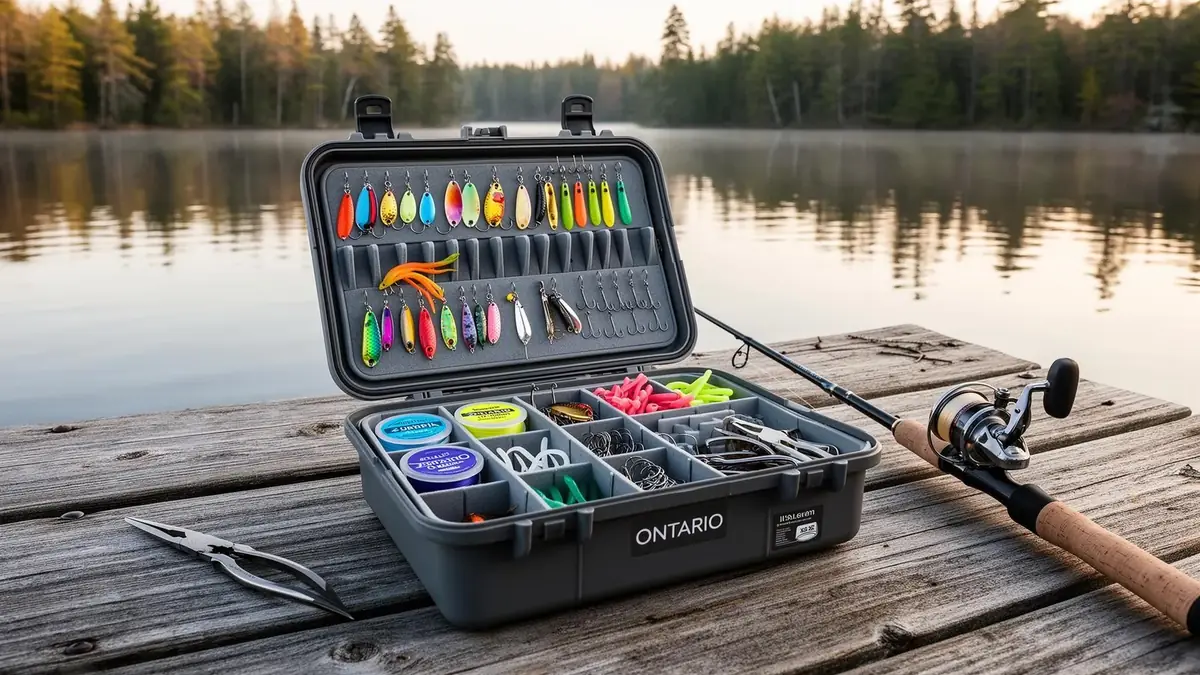
The Ultimate Ontario Tackle Box Checklist
A practical, Ontario-focused list of the rods, lines, hooks, lures, and tools that actually belong in your box — and why.