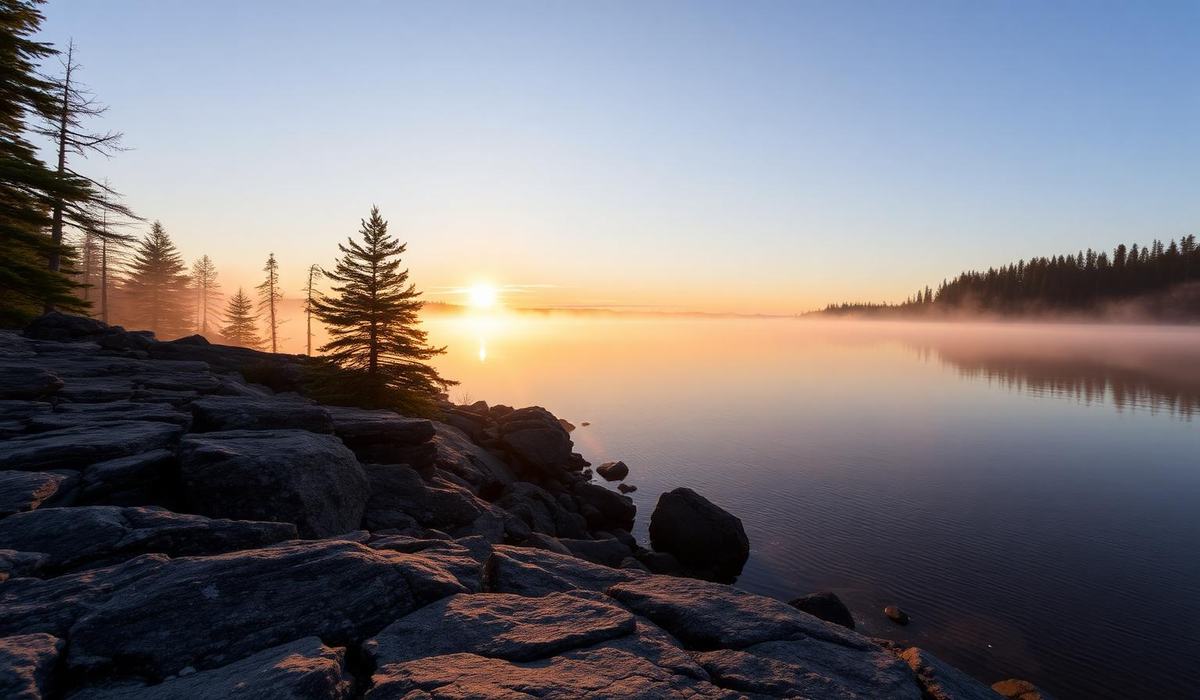
Ontario's 250,000+ inland lakes and the Canadian portion of the Great Lakes facilitate a recreational fishing industry contributing approximately $2.5 billion annually. These systems are now undergoing profound thermodynamic and biological transformation driven by anthropogenic climate change — 'rewiring' food webs and reshaping the fisheries we love.
Since 1970, Northern Ontario has observed a 2.6°C rise in minimum temperatures; Southern Ontario a 1.4°C increase. Through 2100, Great Lakes winter temperatures could rise up to 12°F and summer up to 20°F.
Extended summer stratification isolates the deep, cold hypolimnion — a 'habitat squeeze' for cold-water species like lake trout, increasing 'summer kill' risk. Shorter ice-on times accelerate warming, while extreme precipitation drives 'lake darkening' that hampers visual predators like walleye.
| Climate Metric | 2050 Expectation | 2100 Projection |
|---|---|---|
| Summer Temp | +1–4°C | +3–6°C |
| Winter Temp | +2–7°C | +3–10°C |
| Great Lakes | +2–3°C rise | Sustained warming |
| Water Levels | Lower averages | -1.4 m to +0.4 m |
Generalists like lake trout forage deeper for longer, hunting different prey and altering energy flow between nearshore and offshore. Fish are getting smaller — increased metabolic demand in warmer water often exceeds food supply.
| Fish Guild | Target Species | Outlook & Range Trends |
|---|---|---|
| Cold-water | Lake Trout, Brook Trout | Northward contraction; up to 99% habitat loss by 2100 |
| Cool-water | Walleye, Yellow Perch | Northward shift; 17–22% walleye decline by 2050 |
| Warm-water | Smallmouth Bass | Northward expansion; 260% recruitment increase |
Canada's adult loon (Gavia immer) population dropped nearly 14% between 2005 and 2022. Cloudier water from extreme rainfall hampers visual hunting, and loon chicks now average 11% lighter than in the early 2000s.
- Eliminate Lead & PFAS: Lead poisoning causes up to 30% of adult loon deaths in high-angling areas. Switch to Tungsten, Bismuth or Steel; seek PFAS-free fly lines and waders.
- Trim for Efficiency: Adjusting motor trim once on plane improves fuel efficiency by 10–15%.
- Smart Washing: Wash watercraft on grass or gravel — not over storm drains.
- Keep Fish Wet: Use circle hooks, barbless gear; out of water only as long as you can hold your breath.
- Clean, Drain, Dry: Mandatory to stop round goby and other invaders.
- Bait Management Zones (BMZ): Don't move bait across BMZ boundaries; dispose unused bait on land 30 m from water.
- Citizen Science: Use the MyCatch app and EDDMapS Ontario to report invasive species.
Ontario's fisheries depend on adaptive management — like the 2026 Ontario Fishing Regulations Summary — supported by a dedicated community of angler-stewards. By protecting the 'Many Lakes' we cherish, we ensure 'Endless Adventures' for the next generation.
More fishing near Lake Erie
Topic Hub
Trout Fishing Ontario
Everything you need on this topic
Related Articles
Regulations
Eating the Fish You Catch in Ontario: What You Actually Need to Know
There is no province-wide 'safe' or 'unsafe' lake — here's how Ontario's Guide to Eating Ontario Fish actually works, and how to check your catch before dinner.
Regulations
Are Fishing Pressure and Social Media Killing Hidden Lakes?
Geotags, viral videos, and new access roads are eroding the buffer that once kept Ontario's secret lakes secret — and the science backs it up.
Regulations
Troubled Waters: Why Ontario's Lakes Are in Crisis — and What's Being Done About It
From forever chemicals in northern drinking water to algae blooms creeping into once-pristine cottage lakes, Ontario's freshwater is under mounting pressure. Here's what's actually happening, and what anglers can do.
Topic Hub
Trout Fishing Ontario
Everything you need on this topic