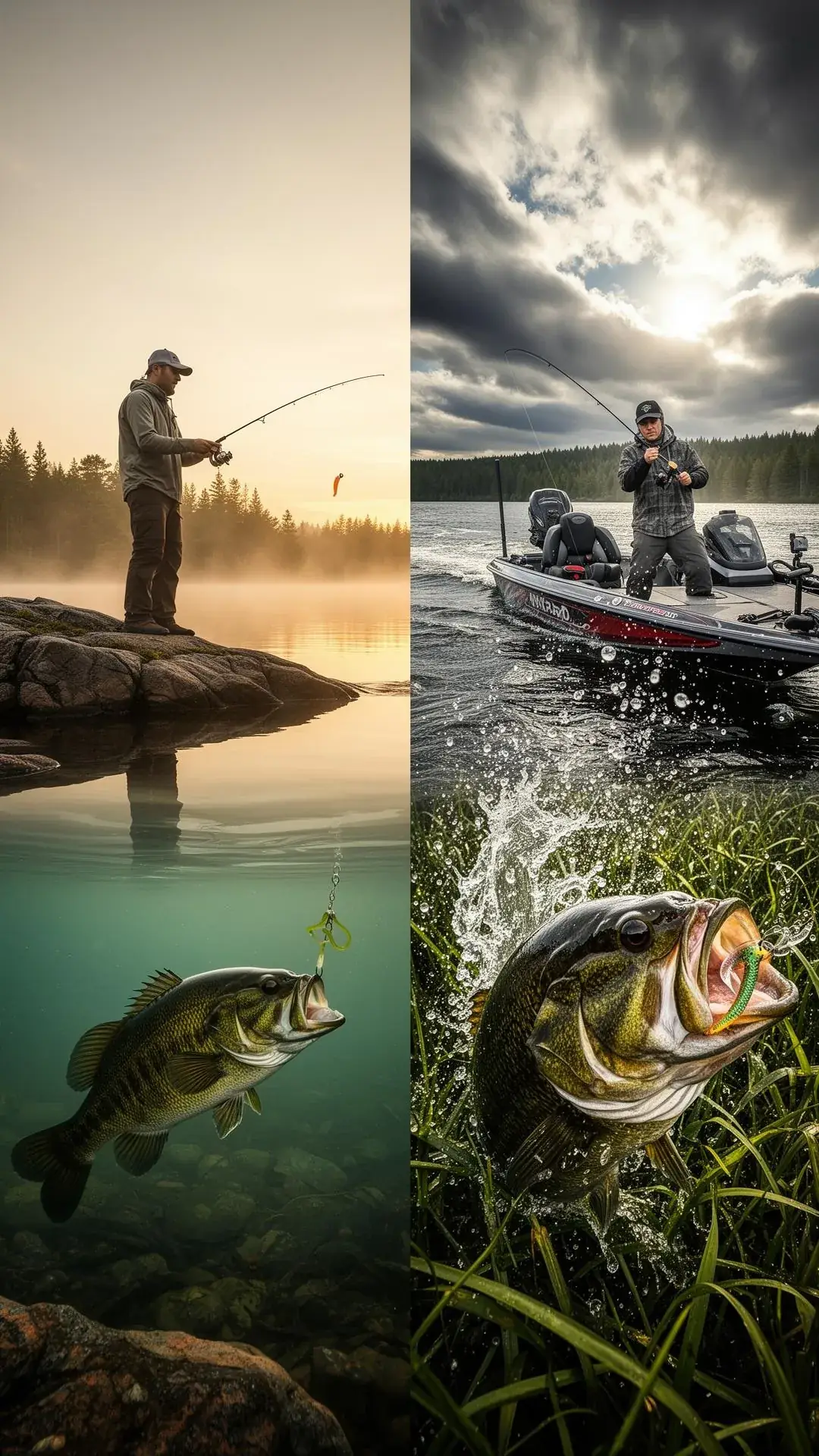
There's a moment every bass angler knows. The line goes tight, the rod loads up, and something bulldozes toward deep water with a violence that feels almost personal. In Ontario, that moment can happen on a cottage-country lake you've fished a hundred times — or on a remote northern system where you're the only boat for twenty kilometres in every direction. What makes Ontario extraordinary isn't just that bass are here. It's that world-class bass are here, year after year, in water as diverse and dramatic as the province itself.
Whether you're chasing the bronze-shouldered fury of a smallmouth or the thick-bodied, weed-crashing power of a largemouth, here's where Ontario's biggest bass show up every single season.
Ask any serious bass angler on the continent where the biggest smallmouth live, and the St. Lawrence River keeps coming up. It isn't hype. In 2020, pro angler Stephen Mueller landed a 7-pound, 13-ounce smallmouth on Lake Ontario during the Bassmaster Elite at the St. Lawrence River — believed to be the largest smallmouth ever caught at elite-level professional tournament bass fishing. Bassmaster Magazine has ranked the St. Lawrence among the top bass fisheries in North America for over a decade, including a No. 1 ranking in 2019.
The Thousand Islands stretch, threading between Ontario and New York State, is the engine behind those numbers. Cold, clean, current-influenced water. Rocky shoals, submerged humps, and granite ledges that hold forage year-round. Smallmouth here grow thick and strong, and five-pound fish are caught often enough that experienced anglers barely photograph them anymore. For largemouth, the shallower backwaters and weed-choked bays deliver three-to-five-pound fish regularly, with the odd specimen pushing past six.
Come in late June through September for peak action. The fish are on full summer patterns, and the scenery — historic castles on mid-river islands, freighters gliding past on the shipping lane — is unlike anything else in freshwater fishing.
There is a reason Georgian Bay smallmouth have a reputation that extends far beyond Ontario's borders. The Bay, part of Lake Huron, covers over 15,000 square kilometres and is studded with more than 30,000 islands — every one of them a potential bass magnet. The eastern and northern shores are legendary, producing five-pound smallmouth with enough regularity that the term 'trophy' gets redefined.
The water here is exceptionally clear and cold, which means bass feed aggressively when conditions are right, and the forage — crayfish, gobies, shiners — is abundant. Smallmouth in Georgian Bay are deep-bodied, hard-fighting fish that seem to have evolved specifically to test light tackle and leader knots. Target rocky points, mid-lake reefs, and the windswept faces of outer islands from late June through October.
Access varies. Some of the best water requires a boat capable of handling open-Bay chops — but those willing to make the run are routinely rewarded with one of the most spectacular bass fishing experiences in Canada.
Tucked along the northern shore of Lake Ontario roughly two hours east of Toronto, the Bay of Quinte is shaped like a long, lazy 'Z' — and it fishes like a dream for anglers targeting big largemouth. A thriving tournament scene, including the annual Quinte Fishing Series, has made it one of the most competitively fished bass destinations in the province.
What makes Quinte special for largemouth is structure and warmth. The Bay's shallower, nutrient-rich water grows dense weed beds — milfoil, coontail, lily pads — that largemouth use to ambush prey all summer long. Topwater fishing can be phenomenal here from July through early September. Ontario's provincial record largemouth (10.43 lb, caught at Preston Lake) shows what's possible on this kind of water.
Less than two hours from Toronto, Rice Lake has earned a reputation as a largemouth factory — beloved, well-documented, and fished hard for generations. Sitting in the heart of the Kawartha Lakes region and connected to the Trent-Severn Waterway, it produces big fish consistently enough that tournament anglers return season after season despite the pressure.
Extensive weed growth, shallow bays, and fallen timber create ideal largemouth habitat. Four-pound fish are common; five-pounders show up regularly throughout summer. The broader Kawartha region — Pigeon, Buckhorn, Sturgeon — offers similarly productive largemouth water with slightly less pressure. For anglers based in southern Ontario, this corridor is the most accessible world-class bass fishery in the province.
Lake Simcoe — covering 722 square kilometres between Barrie and Newmarket — is famous as the 'Ice Fishing Capital of the World,' but its reputation as an open-water smallmouth fishery is equally deserved. Clear water and rocky structure create ideal conditions for trophy smallmouth, and summer fishing from June through September consistently produces three-to-five-pound fish.
What makes Simcoe valuable beyond the fish itself is access. Multiple public boat launches, nearby accommodations, and a well-established charter and guide industry mean anglers don't need to organize an expedition to fish here. It's a weekend trip from virtually anywhere in southern Ontario.
Lake Lauzon in the Algoma Mills region — midway between Sudbury and Sault Ste. Marie — produces smallmouth up to seven pounds every season. Clear water lets bass see prey easily, and mid-lake rock reefs, island points, and shoals create ideal holding structure year-round.
Little Vermilion Lake near Sioux Lookout is one of the most reliable numbers fisheries in the province — an eleven-lake system roughly sixteen miles long where smallmouth seem to inhabit every available piece of structure. In Northeastern Ontario, the Cassels-Rabbit Lakes chain in Temagami routinely produces big numbers of quality smallmouth from early summer through fall.
Ontario's bass season officially opens on the fourth Saturday in June for both largemouth and smallmouth in most management zones — Zone 20 (Lake Ontario, Bay of Quinte, St. Lawrence River) operates on a different schedule, and catch-and-release opportunities exist even earlier in certain Northern Ontario regions. Peak fishing runs from late June through late September, with August often producing the largest fish as bass feed aggressively ahead of fall.
Ontario's provincial smallmouth record sits at 9.84 pounds (Birchbark Lake). The largemouth record stands at 10.43 pounds. On any given summer morning, on any of the waters above, an angler with the right presentation could be looking at a fish that challenges both. That possibility — remote but real, season after season — is what keeps people coming back to Ontario bass water for a lifetime.
More fishing near Georgian Bay
Topic Hub
Bass Fishing Ontario
Everything you need on this topic
Related Articles
Seasons
The Ultimate Summer Fishing Guide for Ontario Anglers
What's biting, where to find them, how to fish them, and what gear to bring for every major summer species in Ontario.
Fishing Spots
Ontario's Top 5 Bass Lakes Right Now
Lake St. Clair, Simcoe, the Thousand Islands, Georgian Bay and Rice Lake — where to fish bass opener and what you need to know.
Fishing Spots
Top 10 Shore Fishing Locations in Ontario
Your Complete Bank Angler's Guide — No Boat Required.