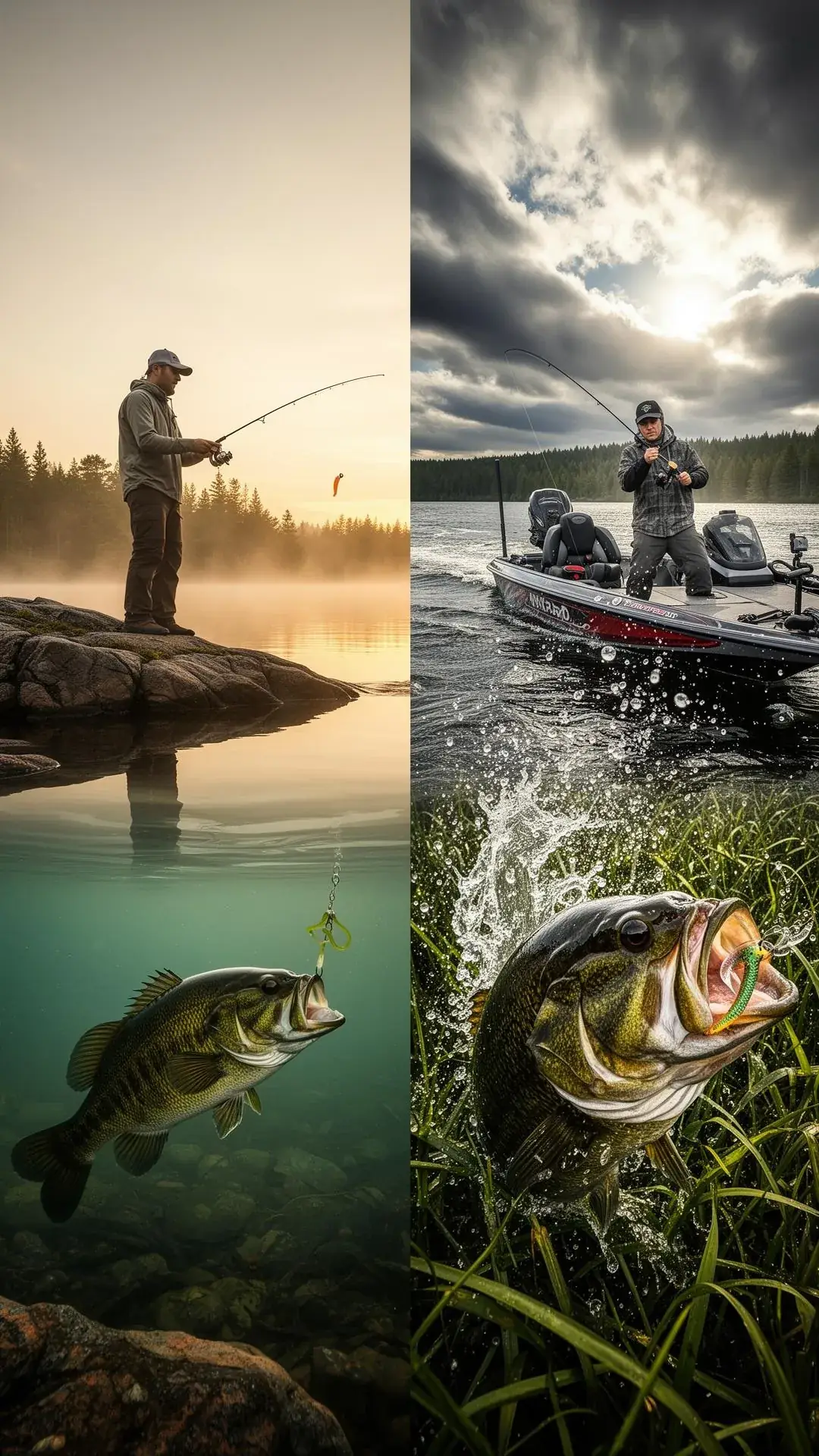
You've fished two lakes in the same week, separated by forty kilometres of Ontario highway. One of them gave you a personal best — a thick, deep-bodied bass that barely fit in the net. The other gave you a morning of dinks. You drove home wondering what you did differently. The answer, more often than not, has nothing to do with you. It has everything to do with the lake.
Ontario has roughly 250,000 lakes. Not all of them are created equal, and the gap between a lake that produces trophy bass and one that tops out at modest fish is rarely explained by chance or angler skill alone. Biology, chemistry, geology, food chain dynamics, and yes, human behaviour all play a role. Understanding those factors doesn't just make you a smarter angler — it fundamentally changes where you choose to spend your time on the water.
The single most important factor in determining whether a lake can grow big fish is how productive it is at its base — how much biological energy the water column generates. Scientists classify lakes by their trophic state, which is essentially a measure of nutrient richness and biological output.
Oligotrophic lakes — think many of Ontario's deep, clear Canadian Shield lakes in the north — are nutrient-poor. Low concentrations of phosphorus and nitrogen limit algae growth, which limits zooplankton, which limits forage fish, which limits the size and density of predators at the top of the chain. These lakes are beautiful, they're often pristine, and they tend to produce cold-water species like lake trout that have evolved to thrive on sparse rations. For big bass, however, they are the wrong end of the spectrum. Fish in oligotrophic water simply don't have enough food to achieve exceptional growth.
Eutrophic lakes sit at the opposite end. Rich in nutrients, often from agricultural runoff or naturally fertile soils, these lakes grow abundant aquatic vegetation, dense zooplankton communities, and thriving populations of forage fish. The Kawartha Lakes — Rice Lake, Scugog, Pigeon Lake, Buckhorn — are classic examples of productive, nutrient-rich Ontario water. They grow largemouth bass because largemouth are warmwater fish that thrive in exactly those high-productivity, weedy environments. The tradeoff is that eutrophic lakes can tip too far: when nutrient loading becomes excessive, oxygen levels crash, algal blooms proliferate, and a lake that once produced trophy fish becomes a management problem.
The sweet spot for trophy bass production sits between these extremes — a lake productive enough to generate a robust forage base, but balanced enough to maintain water quality and oxygen levels throughout the season. Biologists sometimes describe this as the mesotrophic range, where nutrient levels support high fish biomass without the instability of a system that has crossed into excess.
One of the most important principles in fisheries biology is the concept of trophic conversion efficiency: on average, it takes roughly ten pounds of forage to produce one pound of predator fish growth. A bass that weighs five pounds has consumed approximately fifty pounds of smaller fish, crayfish, and invertebrates to get there. That means a lake capable of producing five-pound bass must have a forage base dense enough to sustain that kind of consumption — multiplied across every bass in the system.
This is why forage abundance is a defining characteristic of every legitimate trophy fishery. Lakes with robust populations of shiners, perch, crayfish, and other prey keep bass growing through the season. When that base is thin or disrupted, individual fish growth slows or stalls. A lake with too many bass and too little food doesn't produce big fish — it produces large numbers of stunted, under-nourished fish competing for the same limited resources. Trophy bass fisheries typically support somewhere between 15 and 40 bass per acre, a figure that reflects the carrying capacity of a healthy, balanced food chain.
The composition of the forage base matters as well. A lake where bass can access calorie-dense, easy-to-catch prey grows fish faster than a lake where prey is scarce or evasive. Which brings us to one of the more counterintuitive stories in Ontario bass fishing.
When round gobies first arrived in the Great Lakes in the early 1990s — introduced through the ballast water of ships from Eastern Europe — they were immediately recognized as a serious ecological threat. They were right to be worried: gobies compete with native bottom-dwelling species, raid bass nests, and have spread aggressively through the Great Lakes system and into connected waterways including Lake Simcoe, the Trent River, and Rice Lake.
But what happened next surprised researchers. Smallmouth bass, which are opportunistic predators, quickly recognized the round goby as abundant, easy prey. Studies conducted on eastern Lake Ontario found that round gobies represented up to 86 percent of smallmouth bass stomach contents. And here is the remarkable part: smallmouth bass in Lake Erie showed length increases of 11 to 15 percent at ages two to four following goby invasion, with measurably faster growth rates across the population.
Bass in Lake Ontario and the St. Lawrence River — systems with dense goby populations — now have access to a virtually unlimited year-round food source that didn't exist thirty years ago. It is, at least in part, why the Great Lakes system and the St. Lawrence River corridor consistently produce the largest smallmouth bass in Ontario. A fish that can gorge on gobies from June through October grows faster and bigger than a fish working harder for crayfish and shiners on an inland lake without this supplemental food source.
The lesson isn't that invasive species are good — they're not, and the goby's impacts on native species and nest success have been genuinely damaging. The lesson is that forage availability is a powerful growth lever, and when that lever is pulled hard, the bass at the top of the food chain respond accordingly.
Food alone isn't the whole answer. A lake also needs the right physical environment to let fish grow old enough to become trophies. Structure — the physical features of a lake's bottom and shoreline — determines whether bass can find the shelter and ambush positions they need to feed efficiently and conserve energy.
Smallmouth bass favour rocky shoals, submerged points, boulder fields, and hard-bottom transitions where crayfish are abundant and clear water allows them to spot prey at distance. Lakes with varied, complex structure spread fish across the system, reducing competition and allowing individual fish to establish territories with reliable access to food. Georgian Bay and the St. Lawrence River are structured this way — vast, varied, with enough real estate to support large individual fish without intense crowding.
Largemouth bass tell a different story. They are ambush predators built for weedy, shallow environments. A lake without dense weed growth, fallen timber, or submerged cover is a lake without largemouth trophy potential, regardless of how nutrient-rich the water is. The weeds serve two functions: they give the bass a place to hide and hunt, and they protect forage species long enough for them to grow into prey that puts real weight on a bass. Rice Lake and the Bay of Quinte produce big largemouth because they have extensive weed beds, warm shallow water, and the structural complexity that largemouth evolved to exploit.
Depth matters too. A lake that is uniformly shallow heats quickly, can suffer summer oxygen depletion in heat waves, and offers bass no cool-water refuge during stress periods. A lake with a thermocline — a distinct layer where temperature drops sharply — gives bass a place to go when surface water becomes too warm, preserving their energy budget and allowing continued feeding rather than survival mode.
Ontario's geology divides the province into fundamentally different fishing territories. South of the Canadian Shield — across the Kawartha Lakes, the Rideau system, the St. Lawrence corridor, and the southwestern agricultural lowlands — soils are richer, runoff is more nutrient-laden, and lakes are inherently more productive. These are the waters that grow big largemouth bass, and where the combination of warm water, weed growth, and food chain productivity makes trophy fish a reasonable expectation rather than a pleasant surprise.
On the Shield itself, the ancient granite bedrock that defines the Muskokas, Temagami, Algonquin, and the vast northern boreal means lakes drain into and from stone. Nutrients don't accumulate the way they do in agricultural watersheds. The water stays cold, clear, and relatively sterile. This is beautiful for paddlers and loons. It is not inherently productive bass country — unless the lake has specific local characteristics, like a significant tributary bringing nutrients from a productive drainage, or proximity to wetland systems that filter organic material into the main lake.
The exceptions on the Shield — the lakes that do produce trophy smallmouth despite their northern, granite-bounded geography — tend to share one trait: enough structural complexity and forage availability to compensate for what the chemistry can't provide. Little Vermilion Lake and Lake Lauzon in Northern Ontario are productive partly because their physical environments are so varied and their bass populations so lightly pressured that fish simply live longer and grow larger before an angler ever encounters them.
Here is the uncomfortable truth that no amount of chemistry or geology can work around: you can have the most productive lake in Ontario, with ideal forage, perfect structure, and exceptional water quality — and intense fishing pressure can still prevent it from reaching its trophy potential.
Trophy fish are, by definition, old fish. A smallmouth bass weighing five pounds in Ontario is likely seven to ten years old. A largemouth pushing six pounds has probably survived eight or more seasons. Every year that fish lives, it grows. Every year it's caught and killed — or caught, stressed, and unable to recover — is a year it doesn't add to its weight. Heavily pressured lakes lose their biggest fish fastest. When the dominant cohort of large, breeding-age fish is consistently removed or repeatedly stressed through intensive tournament and recreational activity, the population's size structure collapses toward younger, smaller fish.
This is why remote lakes in Northwestern Ontario and Northern Ontario frequently produce bigger fish than lakes ninety minutes from Toronto, even when the southern lakes are more chemically productive. Lake of the Woods and the Temagami chain don't just have fish — they have old fish that have had years of relatively undisturbed feeding. Paudash Lake in the Kawarthas, a recognized trophy largemouth destination, is frank about the pressure it absorbs: local anglers and guides acknowledge openly that the fishing has become harder as tournament activity and recreational pressure have increased, even though the lake's biological productivity hasn't changed.
The culture around a fishery matters. Lakes where voluntary catch-and-release is practised widely, where trophy fish are revered rather than filleted, and where tournament organizers release fish carefully near their original capture locations consistently produce larger fish over time. Bigger females produce more eggs; protecting them keeps the population's growth potential intact season after season.
When you're choosing where to fish, you're implicitly making a series of decisions about all of these factors — whether you know it or not. The lakes that produce Ontario's biggest bass tend to share a recognizable profile: they sit in productive watersheds or have access to exceptional forage, they offer structural complexity that lets individual fish find reliable feeding territory, their water quality stays in a range that keeps bass actively growing rather than surviving, and their fish populations aren't being systematically hammered back before they can reach their potential.
That doesn't mean every great Ontario bass lake is remote and untouched. Some of the most productive fisheries in the province absorb significant angling pressure and still deliver big fish — because the underlying biology is strong enough to sustain it. But it does mean that the angler who understands what makes a lake tick has a meaningful advantage over the one who simply drives to the nearest ramp.
The biology is the baseline. The fish don't lie.
Tight lines.
Topic Hub
Bass Fishing Ontario
Everything you need on this topic
Related Articles
Species Guides
Hooked Ontario: The Ultimate Angler's Field Guide
A Professional Manual for Species Identification, Strategy, and Technical Success
Species Guides
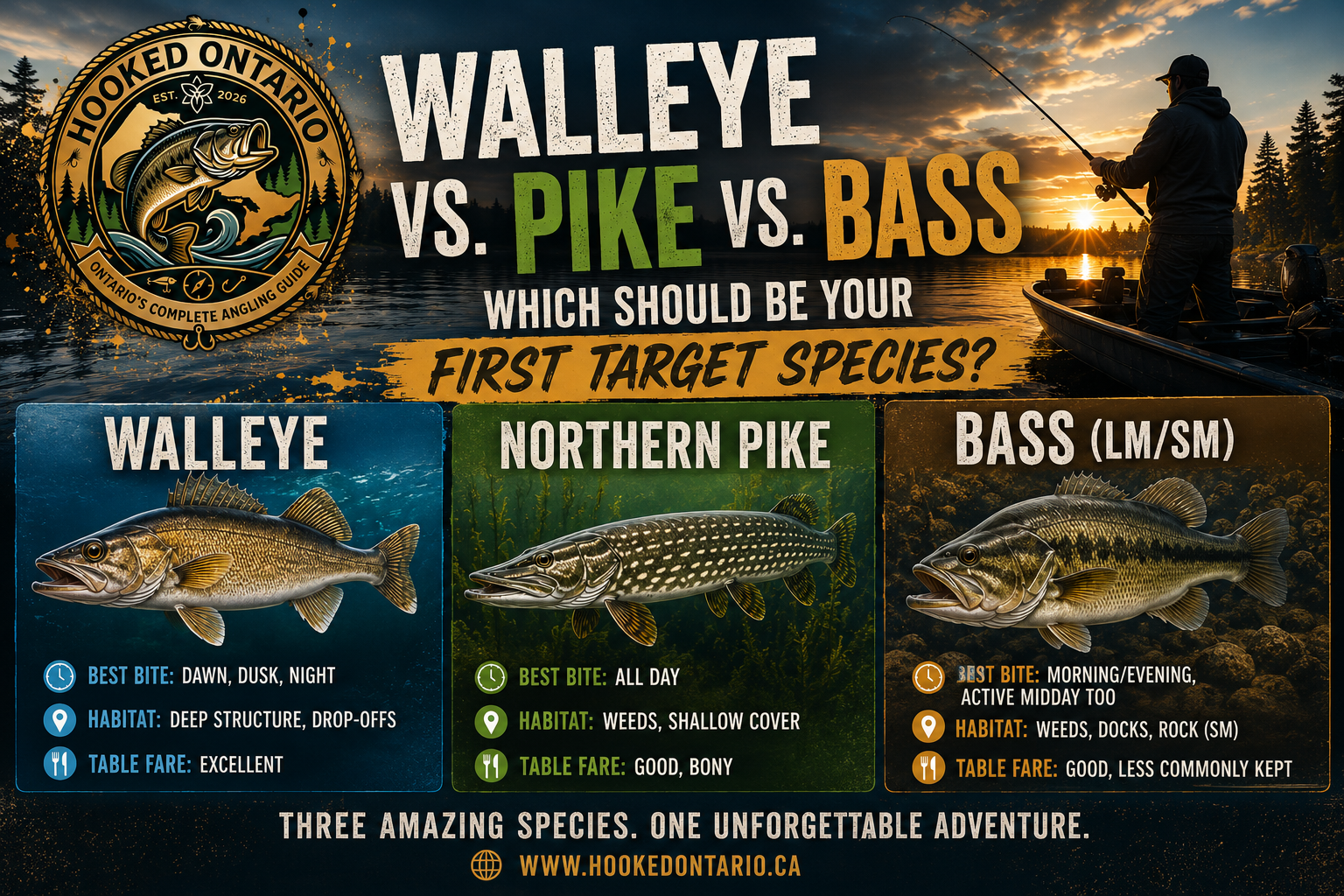
Walleye vs. Pike vs. Bass: Which Should Be Your First Target Species in Ontario?
An honest beginner's breakdown of Ontario's big three — difficulty, bite windows, habitat, gear needs and table fare — so you pick the right species to learn on.
Species Guides
How Water Temperature Shapes Ontario Fishing (And How to Use It to Your Advantage)
Fish are cold-blooded — learn to read water temperature and you'll spend a lot less time guessing where they are and how they'll bite.